🕳️ Released Phantom Node 96: Samarkand Logistics Hub. The Crossroads of Ghosts
- Foundation date
22 December 2025
This project is a philosophical and artistic study of the phenomenon of "phantom nodes" — invisible yet influential objects and subjects in the contemporary global system. The descriptions contained within this study are metaphorical and allegorical, aimed at uncovering systemic problems, regimes, and civilisational influences. They are not a journalistic investigation or legal accusations, but serve as an artistic interpretation of reality.
Names are included because they appear in open international sources.
This creation is protected and cannot be used by third parties for the purpose of supporting, propagating, or legitimizing criminal regimes, terrorist states, and organizations operating in the shadows. The use of data or analysis results from this project, whether in part or in full, is expressly prohibited if the objective is to support or conceal their criminal activity.
The project may be freely used by individuals and organizations that combat evil, corruption, and aggression.
Mode: Shadow Traffic and Opportunistic Transit
🕳️ Released Phantom Node 96: Samarkand Logistics Hub. The Crossroads of Ghosts
The ancient Silk Road repurposed as a corridor of military contraband.
Who is this?
The Samarkand Logistics Hub is not a single facility but a constellation of transit routes, terminals and intermediaries in Uzbekistan that have become a key re-export channel for Western technologies into Russia. Samarkand functions here as a metaphorical “invisible bridge” through which dual-use components reach Russia’s military-industrial complex. Historical trade has been transformed into a modern sanctions-evasion pipeline.
Type of node:
Logistical and transit infrastructure
Status:
Formally neutral, functionally complicit
Form of control:
Re-export schemes, transit loopholes, nominal distributors
Phantom image:
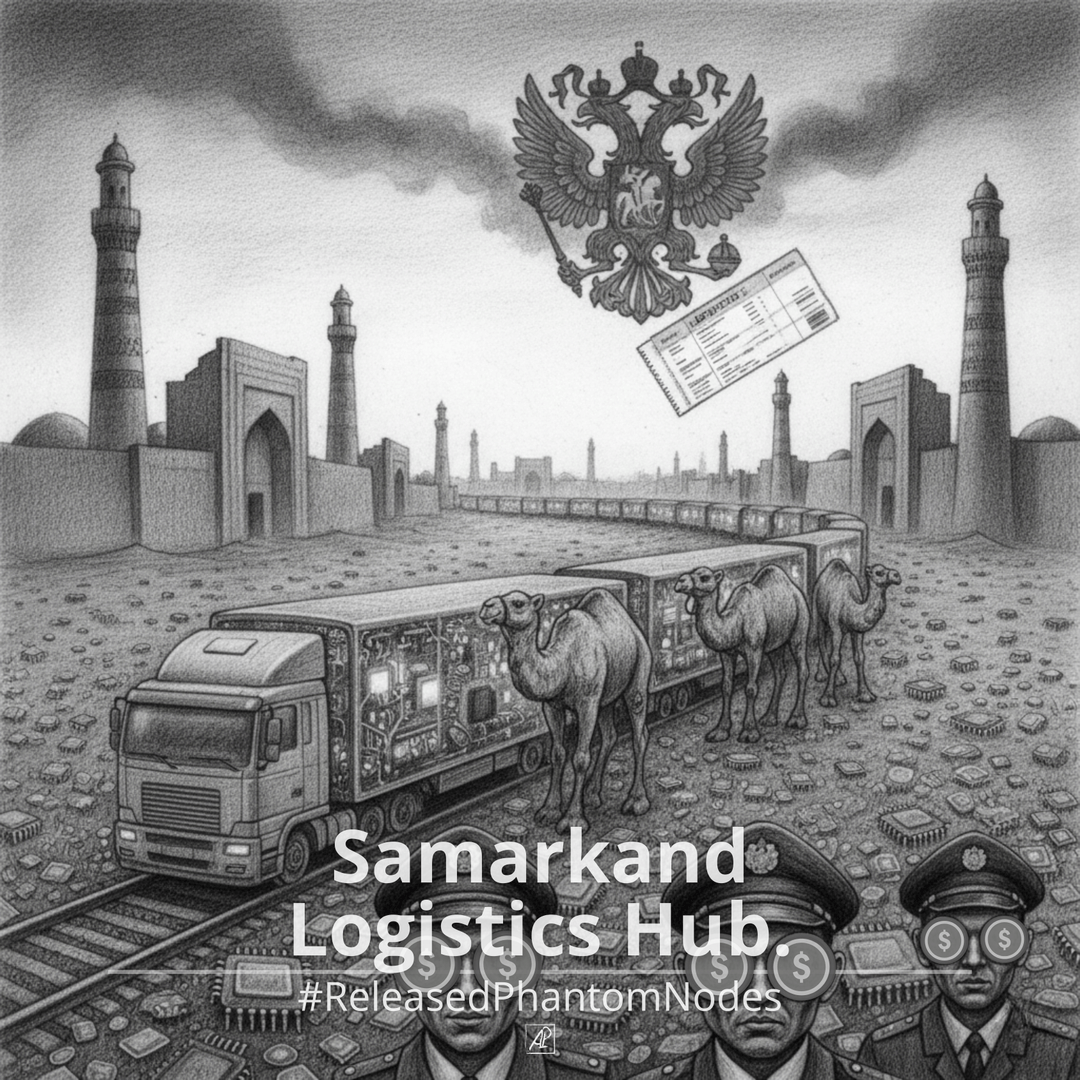
A ghost caravan of trains and trucks moving without trace
What remains after the phantom:
Routes without accountability, contracts without final recipients
Core of the node:
What sustained it?
Geography, weak oversight of dual-use goods, transit profits for local elites, and fragmented international export control.
How did it become a phantom?
When logistics began disguising military supply as civilian trade, the node lost its visible form and became a shadow network.
Why does the phantom still exist?
Because sanctions can block factories, but not routes.
Phantom’s condition:
Active, mobile, adaptive
After the regime:
Detection and blocking of illegal re-export chains
Dismantling of dual-use logistics routes
Criminal prosecution of operators and intermediaries
Restoration of international export control systems
Transparency in the movement of critical components
Collective reaction:
Routes carry responsibility too.
Neutrality cannot justify war.
Every transit has a name.
Core principle:
War does not live only on the battlefield.
It lives in the routes that make it possible.
Alt-text:
Graphite illustration of a ghost caravan of trains and camels transporting microchips through a desert against the minarets of Samarkand. A symbol of logistical re-export and sanctions evasion supplying Russia’s military industry.
#ReleasedPhantomNodes #Samarkand #PoliticalDesign #PivtorakStudio #MemoryOn #ReleasedPhantomNode #Phantom #LogisticsHub #GhostRoutes #ShadowTransit #SanctionsEvasion #DualUse #MilitarySupplyChains #CentralAsia
Unmasking the Phantom. Pivtorak.Studio. 22.12.2025
🛡️ This project is an artistic and philosophical exploration.
All depictions are allegorical and do not assert facts about specific private individuals without corroborated evidence.
Names appear because they are referenced in open international sources.
🫧 Phantom Node Dossier 92: Samarkand Logistics Hub. The "Shadow Traffic and Opportunistic Transit" Regime.
Key Aspects of the Phantom:
"The Aggressor's Logistics Umbilical Cord." Samarkand and the broader logistics network of Uzbekistan have evolved into a strategic crossroads for bypassing the technological blockade. The essence of this node lies in creating a seamless flow of dual-use goods (chips, drones, machine tools) that officially head to Tashkent but "disappear" or are resold across the border to Russia. It is a node that transforms the ancient Silk Road into a modern "Road of Ghosts."
Regimes:
🐫 Opportunistic Neutrality Regime: Formally adhering to international norms while simultaneously extracting massive profits by servicing Russia's military needs.
📦 Grey Crossroads Regime: Creating legal loopholes where goods change owners and destinations directly within customs warehouses.
📉 Tech-Resuscitation Regime: Supplying the Russian military-industrial complex with components that cannot be produced domestically via a network of front distributors.
🚉 Transit Sovereignty Regime: Leveraging geographic location to demand concessions from the West in exchange for promises of "export control."
Tools:
🏗️ Ghost Logistics Hubs: Warehouses and terminals where cargo is "re-shod" (changing labels and accompanying documentation).
💻 Re-export Shell Firms: Thousands of newly registered companies using local nominees that exist solely to process one or two large batches of electronics.
🛤️ Integrated Infrastructure Pacts: Rail and road routes deeply integrated with Russia, making physical cargo tracking nearly impossible.
🛡️ Customs "Blindness": Corrupt or politically motivated inspection mechanisms that ignore the true value and intent of dual-use goods.
Civilizational Influences:
📉 Erosion of Global Export Controls: Demonstrating that technological barriers are powerless against logistical ingenuity.
☣️ Regional Economic Dependency: Creating a symbiosis between local elites and the Russian military machine, which stifles democratic reforms.
🌍 Market Deformation: Displacing honest business with speculators and shadow actors who control scarce commodity flows.
🩸 Technological Prolongation of War: Direct responsibility for the fact that Western chips continue to be found in missiles killing civilians.
Dissection of a Phantom Node. Pivtorak.Studio. 22.12.2025
🛡️ This project is an artistic and philosophical exploration. Depictions are allegorical and do not allege facts about private individuals without corroborated evidence.
Names are included because they appear in open international sources.