🕳️ Released Phantom Node 79: Technological Ghost. Electronics & Components (IEI, HESA)
- Foundation date
22 October 2025
This project is a philosophical and artistic study of the phenomenon of "phantom nodes" — invisible yet influential objects and subjects in the contemporary global system. The descriptions contained within this study are metaphorical and allegorical, aimed at uncovering systemic problems, regimes, and civilisational influences. They are not a journalistic investigation or legal accusations, but serve as an artistic interpretation of reality.
Names are included because they appear in open international sources.
This creation is protected and cannot be used by third parties for the purpose of supporting, propagating, or legitimizing criminal regimes, terrorist states, and organizations operating in the shadows. The use of data or analysis results from this project, whether in part or in full, is expressly prohibited if the objective is to support or conceal their criminal activity.
The project may be freely used by individuals and organizations that combat evil, corruption, and aggression.
Mode: Civilian Militarization
🕳️ Released Phantom Node 79: Technological Ghost. Electronics & Components (IEI, HESA)
Direct responsibility for manufacturing the majority of weapons used in attacks on civilian infrastructure in Ukraine and conflicts in the Middle East
Who is this?
A technological hub that converts commercially available electronics into combat systems. Iran Electronics Industries (IEI) as electronic integrator and HESA as a major UAV assembler combine COTS components and reverse engineering to mass-produce weapons systems.
Type of node:
Integration technology node (manufacturing + electronics integration).
Status:
Operates under state protection and via civilian covers; many operations are obscured behind legitimate commercial facades.
Form of control:
Distributed workshops, procurement agents, reverse-engineering units, modular UAV assembly lines.
Phantom image:
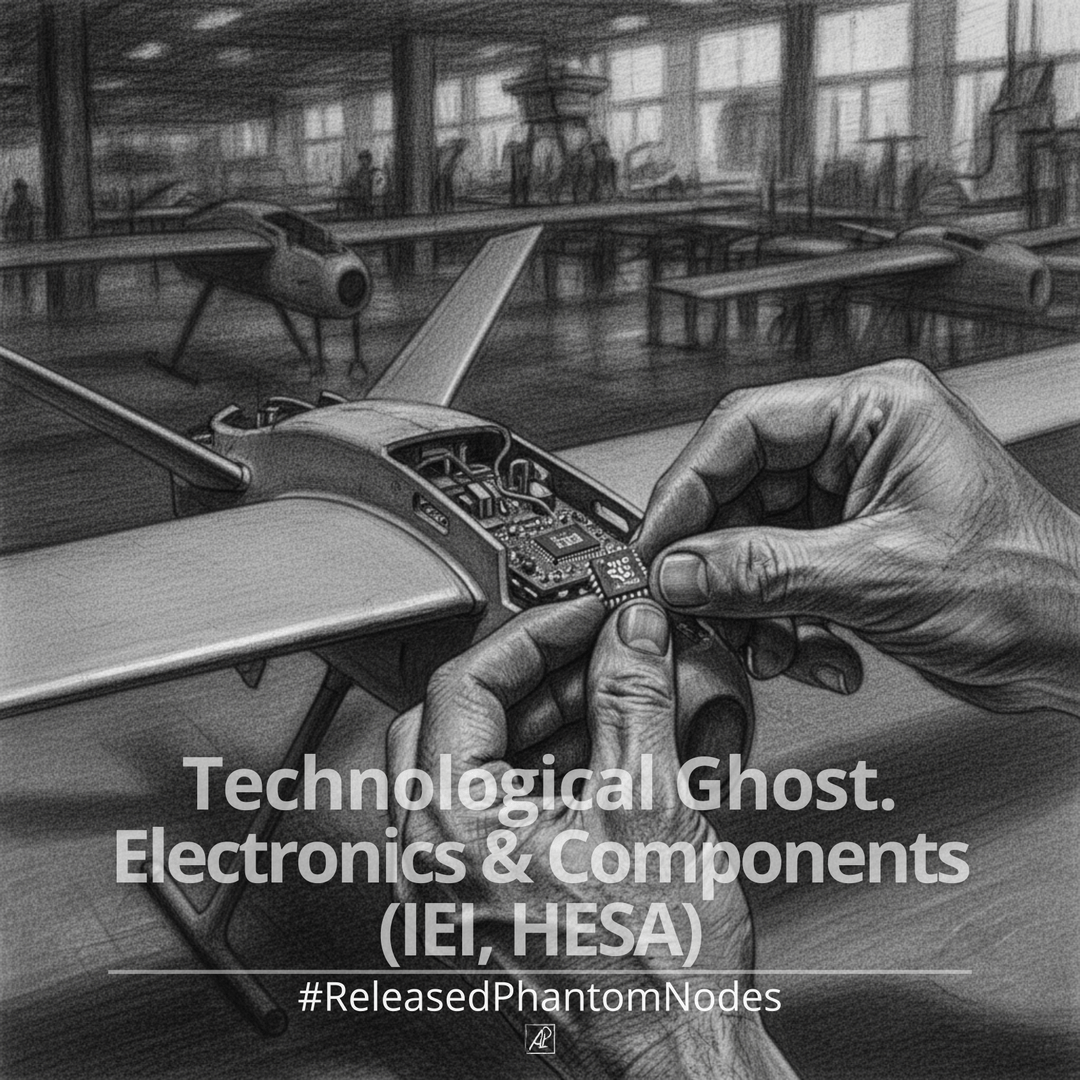
Rough hands insert a tiny foreign-marked microchip into a crude UAV hull; an industrial HESA conveyor looms in the smoky background.
What remains after the phantom:
Supply chains, concealed procurement orders, thousands of assembled units — a machine that continues to function even when individuals are exposed.
Core of the node:
What sustained it?
Global availability of COTS electronics, networks of procurement intermediaries, state funding and distributed manufacturing that masks scale and origin.
How did it become a phantom?
By fragmenting production across many actors and sites, erasing a clear trail to a single proprietor.
Why does the phantom still exist?
Because civilian electronics remain widely available and conversion into weaponry circumvents conventional export controls.
Phantom’s condition:
Active, scalable, technically resilient.
After the regime:
— Unmask supply chains and procurement networks;
— target sanctions on key production nodes;
— coordinate internationally to strengthen COTS export controls;
— hold suppliers and intermediaries to account.
Collective reaction:
Technology should protect life, not make killing cheaper and easier. Demand supply-chain transparency and legal accountability.
Core principle:
When civilian components become weapons, supply-chain governance becomes a matter of global security.
Alt-text:
Graphite drawing: coarse hands inserting a miniature microchip with visible foreign marking into a gray, improvised military UAV hull. The scene symbolizes the integration of civilian electronics into weaponry and the masking of origin.
#ReleasedPhantomNodes #ReleasedPhantomNode #TechnologicalGhost #IEI #HESA #CivilianMilitarization #Electronics #COTS #UAV #Shahed #ReverseEngineering #Procurement #TechProliferation #Iran #WeaponsProduction #ExportControl #SupplyChainSecurity #InternationalSanctions #TechResilience #DistributedWorkshops #Subsidiaries #ProcurementAgents #Accountability #Transparency #Disarmament #TechEthics #MemoryOn #PivtorakStudio
Unmasking the Phantom. Pivtorak.Studio. 22.10.2025
🛡️ This project is an artistic and philosophical exploration. All depictions are allegorical; the piece does not allege facts about specific private individuals without corroborated evidence.
Names are included because they appear in open international sources.
🫧 Phantom Node Dossier 79: Technological Ghost: Electronics and Components (IEI, HESA). The "Civilian Militarization" Regime.
Key Aspects of the Phantom:
"The Civilian Militarization Regime" (or "Integration Node"). The essence of this node is the systematic procurement, reverse engineering, and mass integration of Western-made, Commercial Off-The-Shelf (COTS) microelectronic components into military systems, particularly Iranian UAVs (HESA) and missile complexes (IEI). IEI acts as the primary electronics integrator, while HESA is the key end-manufacturer of proliferating weapons.
Regimes (which it directly shapes/supports):
🤖 Regime of "Civilian Integration": HESA is the prime example: its production (e.g., Shahed) relies entirely on the conversion of commercial microchips, gyroscopes, GPS modules, and engines into military assets, allowing sanctions evasion.
🔬 Regime of "Electronics Replication": IEI manages the process of reverse engineering the most sensitive components (e.g., guidance and communication systems) to create domestic analogues, reducing reliance on procurement networks.
📦 Regime of "Distributed Production Cells": Segmenting production across numerous, often closed, HESA/IEI workshops and subsidiaries to prevent the detection of the full supply chain and production volumes.
💥 Regime of "Mass Proliferation": HESA's capability to rapidly replicate cheap, yet effective UAVs in large volumes (for Russia, proxy groups), making it a key element of the aggressive foreign policy.
Tools (which it actively uses/oversees):
💻 COTS Microelectronics: The direct use of dual-use goods (e.g., Texas Instruments processors, GNSS modules) acquired in Europe and Asia through financial channels.
🏢 IEI/HESA Front Companies: Numerous subsidiaries, registered as "R&D" or "aircraft repair" firms, that act as legitimate buyers in the global electronics market.
📝 UAV Kits/Blueprints: HESA is actively involved in technology transfer (e.g., design and assembly) to its partners (e.g., Russia, during the establishment of factories).
⚙️ Reverse Engineering Labs: Specialized IEI units equipped to analyze and clone foreign avionics and electronics obtained from damaged or captured samples.
Civilizational Influences (which it embodies/exploits):
📉 Erosion of Export Control: This node is evidence of the critical ineffectiveness of global COTS export control mechanisms, as civilian goods are freely militarized.
💸 Democratization of Terror: Lowering the cost threshold for conducting aerial warfare, making lethal technology accessible to authoritarian states and their proxies.
💀 Mass Casualties: HESA bears direct responsibility for manufacturing the majority of weapons used in attacks on civilian infrastructure in Ukraine and conflicts in the Middle East.
👻 The "Phantom Effect": Technological subterfuge that makes judicial and sanctions tracking nearly impossible, as the final product is a blend of dozens of civilian suppliers from various countries.
Dissection of a Phantom Node. Pivtorak.Studio. 22.10.2025
🛡️ This project is an artistic and philosophical exploration. Depictions are allegorical and do not allege facts about private individuals without corroborated evidence.
Names are included because they appear in open international sources.

