🕳️ Released Phantom Node 80: Agents and Diaspora Fronts. Procurement Network
- Foundation date
23 October 2025
This project is a philosophical and artistic study of the phenomenon of "phantom nodes" — invisible yet influential objects and subjects in the contemporary global system. The descriptions contained within this study are metaphorical and allegorical, aimed at uncovering systemic problems, regimes, and civilisational influences. They are not a journalistic investigation or legal accusations, but serve as an artistic interpretation of reality.
Names are included because they appear in open international sources.
This creation is protected and cannot be used by third parties for the purpose of supporting, propagating, or legitimizing criminal regimes, terrorist states, and organizations operating in the shadows. The use of data or analysis results from this project, whether in part or in full, is expressly prohibited if the objective is to support or conceal their criminal activity.
The project may be freely used by individuals and organizations that combat evil, corruption, and aggression.
Mode: Global Private Procurement
🕳️ Released Phantom Node 80: Agents and Diaspora Fronts. Procurement Network
A network of private hunters for technology.
Who is this?
A phantom web of agents, intermediaries and commercial fronts operating worldwide under the guise of legitimate trade. It unites diaspora entrepreneurs and brokers who convert the regime’s money into streams of military technology.
Type of node:
Financial-commercial structure
Status:
Under cover, outside formal jurisdictions
Form of control:
Contractual systems, logistics, corporate law
Phantom image:
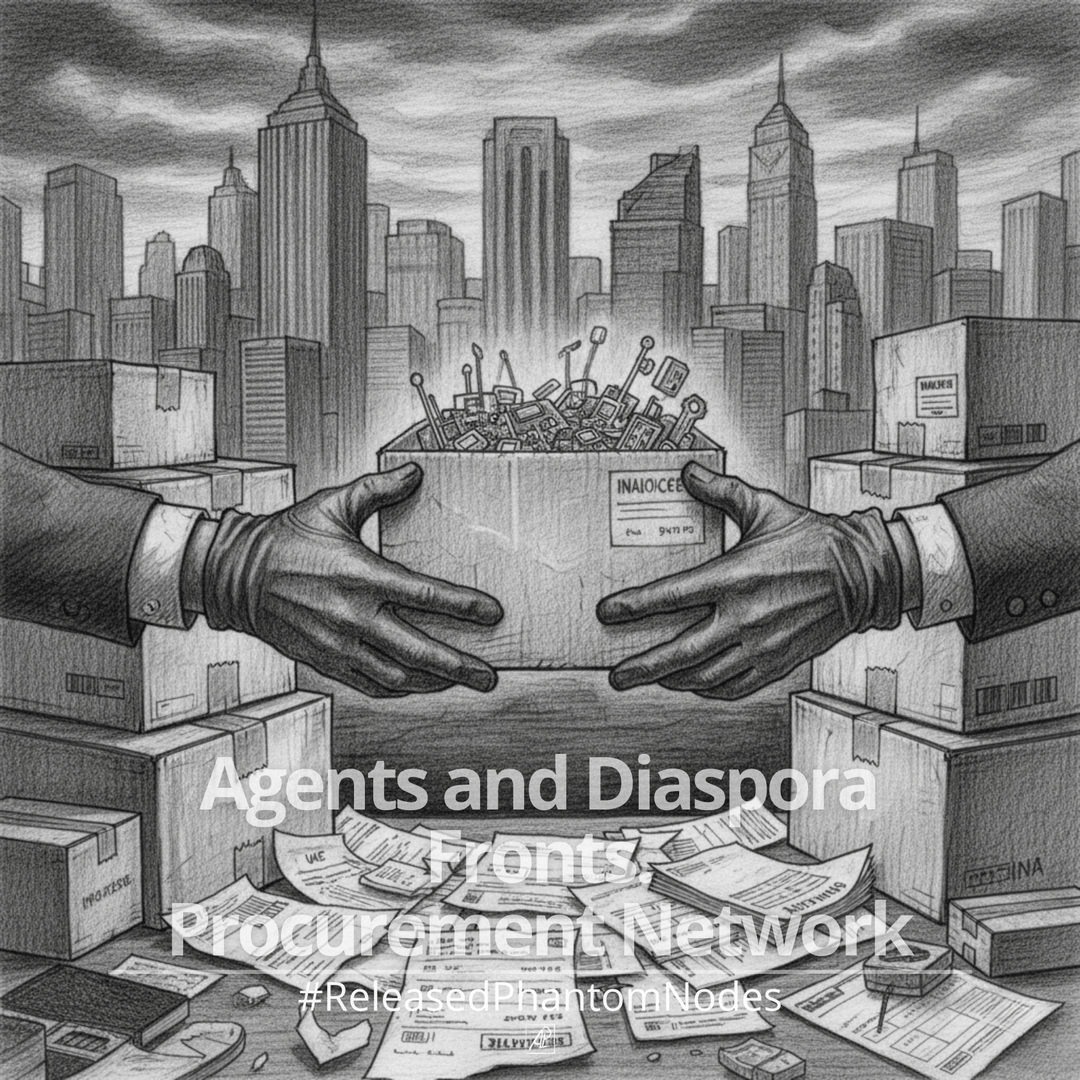
A labyrinth of boxes and papers, with gloved hands passing components marked with false labels.
What remains after the phantom:
Invoices, forged certificates, digital traces in transit hubs.
Core of the node:
What sustained it?
A network of trading and shipping companies in China, the UAE, Turkey and Malaysia. Fragmented purchases evading export control. Dual nationals and corporate shells masking financial flows.
How did it become a phantom?
By merging into global trade, it lost any physical center — turning into a digital shadow where each contract leads to another façade.
Why does the phantom still exist?
Because global markets rely on trust and private initiative — easily abused. Democratic institutions were never built to confront a stateless network.
Phantom’s condition:
Active, decentralized, disguised as legitimate business.
After the regime:
— asset freezes in third countries;
— registry of shell companies;
— identification of operatives through international cooperation.
Collective reaction:
The world learns: invisible intermediaries are part of the war machine.
Every transaction can feed destruction.
Core principle:
A phantom thrives where profit outweighs ethics. Every invoice can become a weapon.
Alt-text:
Graphite drawing: a labyrinth of papers and boxes on a desk. Gloved hands exchange a box with faintly visible electronic components. The scene represents a hidden procurement network through international commercial fronts.
#ReleasedPhantomNodes #ReleasedPhantomNode #ReleasedPhantoms #Phantom #PivtorakStudio #MemoryOn #GlobalProcurement #ShadowTrade #ExportControl #Sanctions #Diaspora #Smuggling #Network #ShadowInterface #InternationalCorruption #TechnologicalTrap #Hawala #ProcurementAgents #IranNetwork #WarEconomy #ShellCompanies #Facade #Labyrinth #Brokers #ProfitVsEthics #InvisibleSystem #Resistance
Unmasking the Phantom. Pivtorak.Studio. 23.10.2025
🛡️ This project is an artistic and philosophical exploration. All depictions are allegorical; the piece does not allege facts about specific private individuals without corroborated evidence.
Names are included because they appear in open international sources.
🫧 Phantom Node Dossier 80: Agents and Diaspora Facades: Procurement Network. The "Global Private Procurement" Regime.
Key Aspects of the Phantom:
"The Global Private Procurement Regime" (or "Private Hunter Network"). The essence of this node lies in the utilization of complex, international networks of independent, often diaspora, agents and registered commercial facade companies to legalize and conceal the procurement of sensitive dual-use goods (COTS). These agents receive funding and clear instructions on precisely which Western components are needed for military production.
Regimes (which it directly shapes/supports):
👤 Regime of "Contracted Recruitment": Hiring professional brokers and individuals with deep ties to international trade who have no direct visible link to the Iranian government or military structures, ensuring a high degree of plausible deniability.
🌐 Regime of "Transit Hubs": Systematic use of third countries (China, UAE, Turkey, Malaysia) as intermediate points to reroute goods through multiple jurisdictions to "sanitize" the supply chain.
💼 Regime of "Commercial Camouflage": Establishing or acquiring existing legitimate trading firms (e.g., electronics, auto parts) to place orders that appear entirely innocuous on paper but contain critical components.
📦 Regime of "Micro-Dispersion": Procuring necessary components in small batches from numerous different suppliers to avoid triggering export control and financial monitoring mechanisms, which focus on large transactions.
Tools (which it actively uses/oversees):
📧 Front Export Companies (FECOs): Legal entities registered in key jurisdictions that act as the official end-user for Western manufacturers, claiming a civilian application for the goods.
🔑 Key Operatives (KOs): Specific individuals, often with dual nationality or Iranian heritage, who physically manage the financial transfers and logistics.
🧾 Forged End-User Certificates: Providing manufacturers and export authorities with false documentation regarding the final user, indicating the goods are intended for "medical equipment" or "academic research."
🗃️ Warehousing Hubs: Utilizing storage facilities in third countries to consolidate dispersed small batches of components before their final shipment to Iran.
Civilizational Influences (which it embodies/exploits):
🛡️ Compromise of Global Trade: Turning the world trade system (especially East Asia) into an unwitting accomplice in funding military aggression, necessitating intervention.
🏛️ Abuse of Legal Norms: Systematic misuse of corporate law principles and freedom of trade, leveraging them to mask criminal activities.
🚨 Threat to Diasporas: Bringing disrepute upon Iranian communities worldwide due to the involvement of a small number of individuals in this criminal network.
📈 Increased Cost of Control: Forcing international governments to invest significant resources in more complex, expensive tracking and export control systems, as existing ones are ineffective against this network.
Dissection of a Phantom Node. Pivtorak.Studio. 23.10.2025
🛡️ This project is an artistic and philosophical exploration. Depictions are allegorical and do not allege facts about private individuals without corroborated evidence.
Names are included because they appear in open international sources.