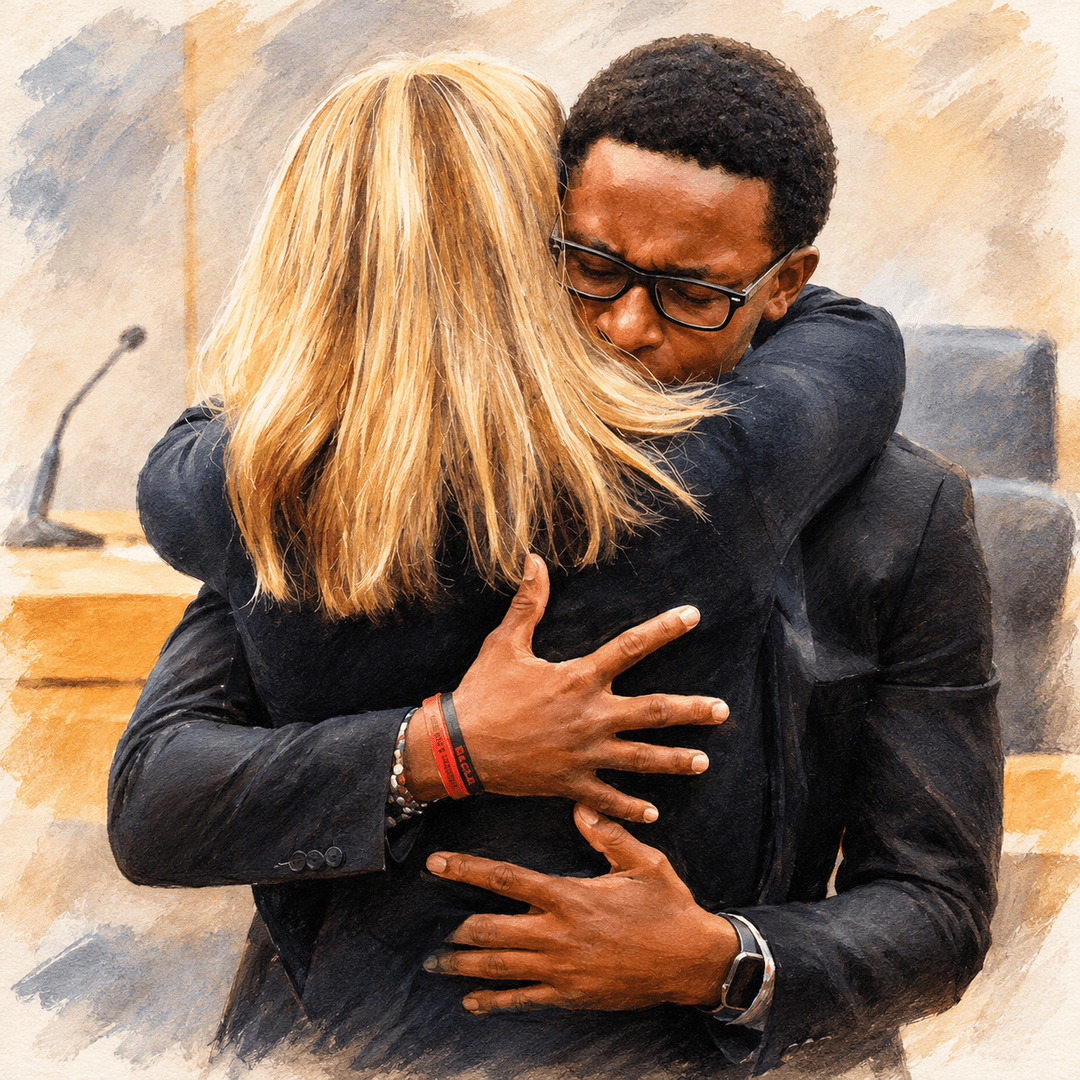
The Power of Forgiveness
- Foundation date
27 November 2026
- Case
The Murder of Botham Shem Jean
- Location
South Side Flats Apartments, Dallas, Texas, USA
- Date of incident
September 6, 2018
- Victim
Botham Shem Jean, 26
- Defendant
Amber Renee Guyger, former Dallas Police Department officer
- Verdict
Guilty of murder
- Sentence
10 years in prison
- Trial court
204th Judicial District Court, Dallas County, Texas
- Presiding judge
Tammy Kemp
This story is remarkable not only because of the crime itself, but above all because of what happened in the courtroom afterwards.
1. Forgiveness is not justification
Amber Guyger committed a crime. An innocent man lost his life in his own home. No circumstances surrounding this tragedy can make his death any less significant.
Brandt Jean's forgiveness does not mean that the crime never happened, that accountability is unnecessary, or that the family's pain has disappeared.
This distinction is fundamental.
A person can forgive someone without justifying what they have done.
2. The greatest strength lies in freedom of choice
Brandt Jean had every reason to feel anger, hatred and a desire for revenge.
He had lost his brother. He had every right to experience those emotions.
Yet he made a different choice.
He did not simply say that he forgave Amber. He wished her well, said he did not want her to go to prison, and asked permission to hug her.
It was an extraordinary act of humanity.
This was not merely an expression of kindness. For Brandt, it was something much deeper: an expression of his Christian faith.
3. Forgiveness cannot be demanded of others
There is another important distinction.
Brandt Jean could forgive Amber on his own behalf. But he could not forgive her on behalf of his deceased brother, his parents, or the other members of the family.
Not everyone who experiences such a tragedy will be able to make the same choice.
His actions should therefore not be treated as a moral obligation imposed on everyone, but as a deeply personal decision.
4. The Christian meaning of forgiveness
The central idea of the video's concluding message is this:
A person who understands how much they themselves have been forgiven can find the strength to forgive others.
This echoes the biblical Parable of the Unforgiving Servant (Matthew 18:21–35).
Christian forgiveness, however, is not a demonstration of moral superiority over someone who has done wrong. It is an acknowledgement that the mercy we receive is not something we have earned through our own merit.
The deeper meaning of this story
Ultimately, this story is not about how good a person can become through being forgiven.
It is about how powerful the human capacity can be to refuse to let another person's wrongdoing define one's own heart.
And there is something else worth remembering.
Brandt Jean did not bring his brother back. He did not undo the tragedy or change the past.
But he demonstrated that even after an irreversible loss, a person can remain capable of love.
And that is what makes this story so unforgettable.
The central message is not the sensational nature of the trial, but the unexpected encounter between justice, forgiveness, faith and human dignity.
Above all, it is important not to lose the voice of Brandt Jean himself. His actions are what made this story so profoundly moving.
Dallas, Texas, USA — September 6, 2018
It was an ordinary Thursday evening in Dallas. But within minutes, an event would take place that would change several lives forever and later become the subject of one of the most widely discussed courtroom moments in the United States.
Amber Guyger was a Dallas police officer returning home after a long shift. She was still wearing her police uniform when she arrived at the South Side Flats apartment complex, where she lived.
Guyger lived on the third floor, in apartment 1378. Directly above her, on the fourth floor, lived 26-year-old Botham Shem Jean, in apartment 1478.
The apartments had almost identical layouts, and the building's parking garage and hallways could make it easy to confuse the floors.
That evening, Guyger parked on the fourth floor of the garage but believed she was on the third. She walked along the hallway and approached what she thought was her own apartment.
The door to Jean's apartment was slightly ajar. When Guyger inserted her electronic key, the door opened.
Inside, the apartment was dark.
Botham Jean was at home, sitting on his couch, watching television and eating ice cream. Hearing someone enter, he stood up to see who was there.
Guyger later testified that she believed she had entered her own apartment and that the person inside was an intruder. She drew her firearm and fired twice. One bullet struck Jean in the chest.
Only after the shooting, while trying to establish the apartment's address for emergency services, did Guyger realise that she was in the wrong home.
She immediately called 911 and requested police and medical assistance. Botham Jean was taken to Baylor University Medical Center, where he died from his injuries.
He had been in his own home. He was unarmed. He was just 26 years old.
The investigation and the trial
The shooting took place on September 6, 2018. Guyger was arrested three days later and subsequently dismissed from the Dallas Police Department.
The case attracted enormous public attention. It raised difficult questions about the use of deadly force, police accountability and the circumstances in which an officer can claim self-defence.
Guyger maintained that she had mistaken Jean's apartment for her own and believed she was confronting a burglar. The prosecution argued that her actions were unreasonable and that an unarmed man had been killed in his own home.
The trial began in Dallas in September 2019.
On October 1, 2019, a jury found Amber Guyger guilty of murder.
The following day, October 2, the jury sentenced her to 10 years in prison.
For Botham Jean's family, the verdict brought a measure of legal accountability, but no sentence could bring their son and brother back.
The moment that changed the courtroom
On the day of sentencing, the court heard emotional statements from members of both families.
Then something unexpected happened.
Brandt Jean, Botham's younger brother, who was just 18 years old, took the witness stand and addressed the woman who had killed his brother.
He spoke about forgiveness, love and faith.
He told Amber Guyger that he did not wish anything bad upon her. He said he wanted the best for her, even though he had lost someone he loved so deeply.
He also told her that he believed his brother would want her to give her life to Christ.
Then Brandt asked the judge, Tammy Kemp, a simple question:
Could he give Amber a hug?
The judge gave him permission.
Brandt stepped down from the witness stand, walked towards Guyger and embraced her in the courtroom. She began to cry.
It was an extraordinary moment: a young man embracing the person responsible for his brother's death, not out of an obligation to forget, but as an expression of forgiveness rooted in his faith.
The judge herself later approached Guyger, gave her a Bible and embraced her as well.
Beyond the courtroom
The embrace between Brandt Jean and Amber Guyger quickly spread around the world.
For many people, it became a powerful example of Christian forgiveness, compassion and the possibility of choosing love even in the face of devastating loss.
Others questioned the moment and the broader context of the case, pointing out that forgiveness should never be expected from victims' families or used to diminish the demand for justice.
The 10-year sentence itself also provoked strong reactions, with some believing it was far too lenient.
These different responses revealed just how complex the questions raised by the case were.
But one thing remains clear: Brandt Jean's gesture was his own personal choice.
He could not change what had happened. He could not bring his brother back. He could not erase the pain of his family.
Yet, in that courtroom, he demonstrated that forgiveness and the pursuit of justice do not necessarily have to be opposites.
Sometimes, even in the aftermath of an unbearable tragedy, a person can choose not to let hatred have the final word.
September 6, 2018 — The shooting
At approximately 9:59 p.m., Amber Guyger, a Dallas police officer who had just completed her shift, entered apartment 1478 at the South Side Flats complex, believing it was her own apartment, number 1378, located one floor below.
Botham Shem Jean, a 26-year-old accountant originally from Saint Lucia, was at home. He was sitting in his living room when Guyger entered. She fired two shots, one of which struck him in the chest.
After realising she was in the wrong apartment, Guyger called 911 and requested emergency assistance. Jean was transported to Baylor University Medical Center, where he died from his injuries.
September 9, 2018 — Arrest
Amber Guyger was arrested on a manslaughter charge, three days after the shooting.
September 24, 2018 — Dismissal from the police department
The Dallas Police Department terminated Guyger's employment following an internal investigation.
November 30, 2018 — Murder indictment
A Dallas County grand jury indicted Guyger for murder, replacing the original manslaughter charge.
September 23, 2019 — Trial begins
The murder trial began in Dallas County. Guyger pleaded not guilty and maintained that she had mistaken Jean's apartment for her own and believed she was confronting an intruder.
September 27, 2019 — Defendant's testimony
Guyger took the witness stand and testified about the shooting, describing her fear and her belief that she had entered her own apartment.
October 1, 2019 — Guilty verdict
After hearing the evidence and arguments from both sides, the jury found Amber Guyger guilty of murder.
October 2, 2019 — Sentencing
The jury sentenced Guyger to 10 years in prison.
Following the sentencing, Botham Jean's younger brother, Brandt Jean, then 18, addressed Guyger in court, told her that he forgave her and asked permission to embrace her. Judge Tammy Kemp allowed the embrace.
November 17, 2021 — Appeal rejected
The Fifth Court of Appeals of Texas upheld Guyger's murder conviction and 10-year sentence.
March 30, 2022 — Further appeal refused
The Texas Court of Criminal Appeals refused to review the case.
November 7, 2022 — Final federal appeal refused
The Supreme Court of the United States denied Guyger's petition for review, leaving the conviction and sentence in place.
Legal Outcome
Amber Renee Guyger was convicted of murder and sentenced to 10 years of imprisonment. Her conviction and sentence were subsequently upheld through the state appellate process, and the U.S. Supreme Court declined to review the case.
2024 — First parole request denied
Amber Guyger's first request for parole was denied after she had served approximately five years of her 10-year sentence.
October 1, 2026 — Parole approved
The Texas Board of Pardons and Paroles approved Guyger's early release after she had served seven years of her sentence.
The decision was based on her satisfactory conduct in prison, the absence of a documented pattern of violent or assaultive offences, and her participation in and completion of rehabilitation and employment-related programmes.
October 16, 2026 — Released from prison
Amber Guyger was officially released from prison in Gatesville, Texas, after serving seven years of her 10-year sentence.
Her release was granted under parole supervision. She remains subject to strict conditions until her original sentence expires in 2029, including travel restrictions and regular supervision.