🕳️ Released Phantom Node 101: Trans-Caspian Corridor. The Artery of Strategic Deception
- Foundation date
29 December 2025
This project is a philosophical and artistic study of the phenomenon of "phantom nodes" — invisible yet influential objects and subjects in the contemporary global system. The descriptions contained within this study are metaphorical and allegorical, aimed at uncovering systemic problems, regimes, and civilisational influences. They are not a journalistic investigation or legal accusations, but serve as an artistic interpretation of reality.
Names are included because they appear in open international sources.
This creation is protected and cannot be used by third parties for the purpose of supporting, propagating, or legitimizing criminal regimes, terrorist states, and organizations operating in the shadows. The use of data or analysis results from this project, whether in part or in full, is expressly prohibited if the objective is to support or conceal their criminal activity.
The project may be freely used by individuals and organizations that combat evil, corruption, and aggression.
Mode: Strategic Obfuscation and Transit Mimicry
🕳️ Released Phantom Node 101: Trans-Caspian Corridor. The Artery of Strategic Deception
Global infrastructure hacked to sustain aggression.
Who is this?
The Trans-Caspian Corridor (Middle Corridor) is an international multimodal transport route designed as an alternative to Russian pathways between Asia and Europe. Its declared goal was to reduce dependency on Russia. In practice, the corridor became an indirect supply channel for dual-use goods feeding Russia’s war machine.
Type of node:
Geo-economic and infrastructural structure
Status:
Legitimized international route under Western investment cover
Form of control:
Transit anonymity, multimodality, diffusion of accountability
Phantom image:
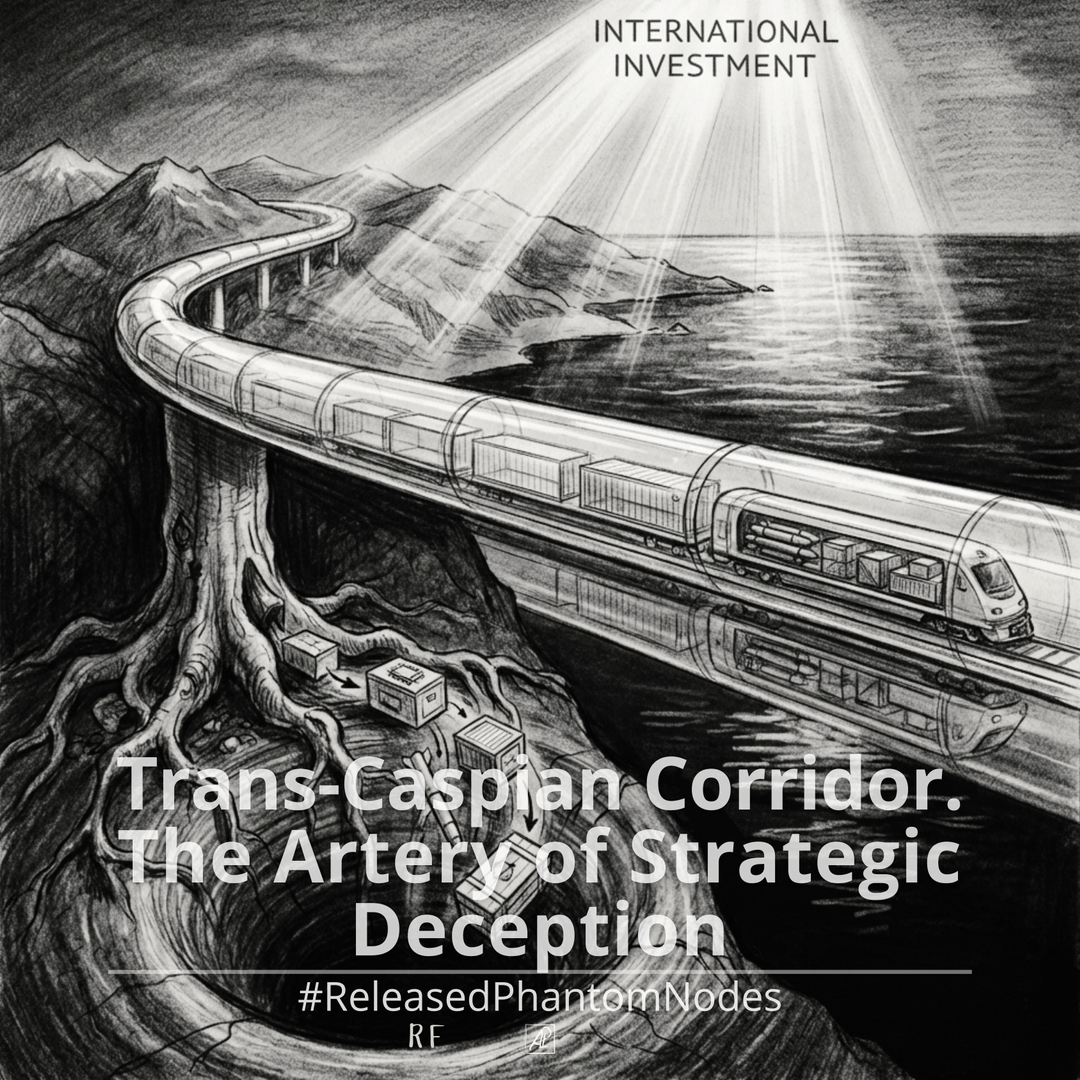
A transparent artery that appears clean from above while hiding shadow roots below
What remains after the phantom:
An opaque logistics scheme and erosion of trust in global routes
Core of the node:
What sustained it?
Western investment, complex multimodal architecture, lack of unified oversight, and weak synchronization of customs and digital systems.
How did it become a phantom?
The corridor lost its original political intent and shifted from a tool of independence to a symbol of systemic deception.
Why does the phantom still exist?
Because of geopolitical mimicry, transit-country dependencies, and the exhausting complexity of sanctions monitoring.
Phantom’s condition:
Active, legalized, strategically diffused
After the regime:
Shadow transit schemes exposed
Multimodal hubs audited
Dual-use supply channels blocked
“Paper transit” criminalized
Transparency and accountability restored
Control over strategic infrastructure returned
Collective reaction:
Global infrastructure can no longer claim neutrality.
Transparency is not a declaration but a duty.
The world’s arteries must not feed war.
Core principle:
Infrastructure without control inevitably becomes a weapon.
Alt-text:
Graphite illustration of the Trans-Caspian Corridor as a glass serpent spine: transparent and legitimate above, with shadow roots below feeding Russia’s military machine.
#ReleasedPhantomNodes #MiddleCorridor #PoliticalDesign #MemoryOn #PivtorakStudio #ReleasedPhantomNode #PhantomNode #Phantom #TransCaspianCorridor #StrategicDeception #GeopoliticalMimicry #TransitAnonymity #DualUseGoods #SanctionsEvasion #GlobalInfrastructure #Logistics #GeoEconomics #Exposure #SystemicFailure #InternationalSecurity #ArteryOfWar #ShadowTransit #Audit #Transparency #Accountability #SystemicCleansing
Unmasking the Phantom. Pivtorak.Studio. 29.12.2025
🛡️ This project is an artistic and philosophical exploration.
All depictions are allegorical; the piece does not allege facts about specific private individuals without corroborated evidence.
Names are included because they appear in open international sources.
🫧 Phantom Node Dossier 101: Trans-Caspian Corridor (Middle Corridor). The "Strategic Obfuscation and Transit Mimicry" Regime.
Key Aspects of the Phantom:
"The Double-Bottom Artery." The Middle Corridor is promoted as a "Silk Road" bypassing Russia. However, its phantom nature lies in how Russia has learned to parasitize this independent infrastructure. It is a werewolf corridor: officially connecting China and Europe, but through "leaks" in the Caucasus and Central Asia, it has become a primary channel for funneling Western tech to Russia under the guise of transit.
Regimes:
🎭 Geopolitical Mimicry Regime: Utilizing the status of an "alternative route" to secure Western infrastructure investments that effectively serve the Russian military-industrial complex.
🌫️ Transit Anonymity Regime: Leveraging multimodality (changing transport: train-ship-truck) to dilute responsibility for cargo inspection at every stage.
📊 Statistical Phantom Regime: Enormous discrepancies between export data from the EU/China and import data to Central Asian nations, where the "missing" goods evaporate toward the Russian Federation.
Tools:
🛤️ Multimodal Hubs: Transshipment points where cargo is re-documented from international transit manifests to internal regional papers.
📜 "Paper Transit": Schemes where goods are documented for Turkey or Europe but physically unloaded within the Customs Union with Russia.
🌐 Compromised Monitoring Platforms: Consciously implementing "leaky" IT tracking systems that are easily bypassed via manual data entry.
Civilizational Influences:
📉 Discrediting Global Projects: Turning a strategic initiative into a tool for aggression, undermining trust in international infrastructure alliances.
⚖️ Depleting Sanction Resources: Creating a network so complex that monitoring it consumes more resources than the sanctions themselves.
🌍 Economic Blackmail: Using the corridor as a lever of influence over Central Asian countries, keeping them logistically tethered to Russian needs.
Dissection of a Phantom Node. Pivtorak.Studio. 29.12.2025
🛡️ This project is an artistic and philosophical exploration. Depictions are allegorical and do not allege facts about private individuals without corroborated evidence.
Names are included because they appear in open international sources.