🕳️ Released Phantom Node 102: Russia’s Shadow Fleet. The Stateless Artery of Global Contraband
- Foundation date
29 December 2025
This project is a philosophical and artistic study of the phenomenon of "phantom nodes" — invisible yet influential objects and subjects in the contemporary global system. The descriptions contained within this study are metaphorical and allegorical, aimed at uncovering systemic problems, regimes, and civilisational influences. They are not a journalistic investigation or legal accusations, but serve as an artistic interpretation of reality.
Names are included because they appear in open international sources.
This creation is protected and cannot be used by third parties for the purpose of supporting, propagating, or legitimizing criminal regimes, terrorist states, and organizations operating in the shadows. The use of data or analysis results from this project, whether in part or in full, is expressly prohibited if the objective is to support or conceal their criminal activity.
The project may be freely used by individuals and organizations that combat evil, corruption, and aggression.
Mode: Maritime Anonymity and Jurisdictional Void
🕳️ Released Phantom Node 102: Russia’s Shadow Fleet. The Stateless Artery of Global Contraband
When the ocean becomes a lawless territory and war turns into insured cargo.
Who is this?
Russia’s shadow fleet is not a collection of ships but an extraterritorial system of hundreds of aging tankers with opaque ownership structures, enabling oil exports beyond sanctions. It operates outside national jurisdictions, functioning as a stateless entity with a continuous financial bloodstream. This node converts physical resources into phantom revenues fueling war.
Type of node:
Financial-logistical / energy / extraterritorial
Status:
Outside the law, under rotating flags, within the global “grey zone”
Form of control:
Jurisdictional fragmentation, fake insurance, electronic invisibility
Phantom image:
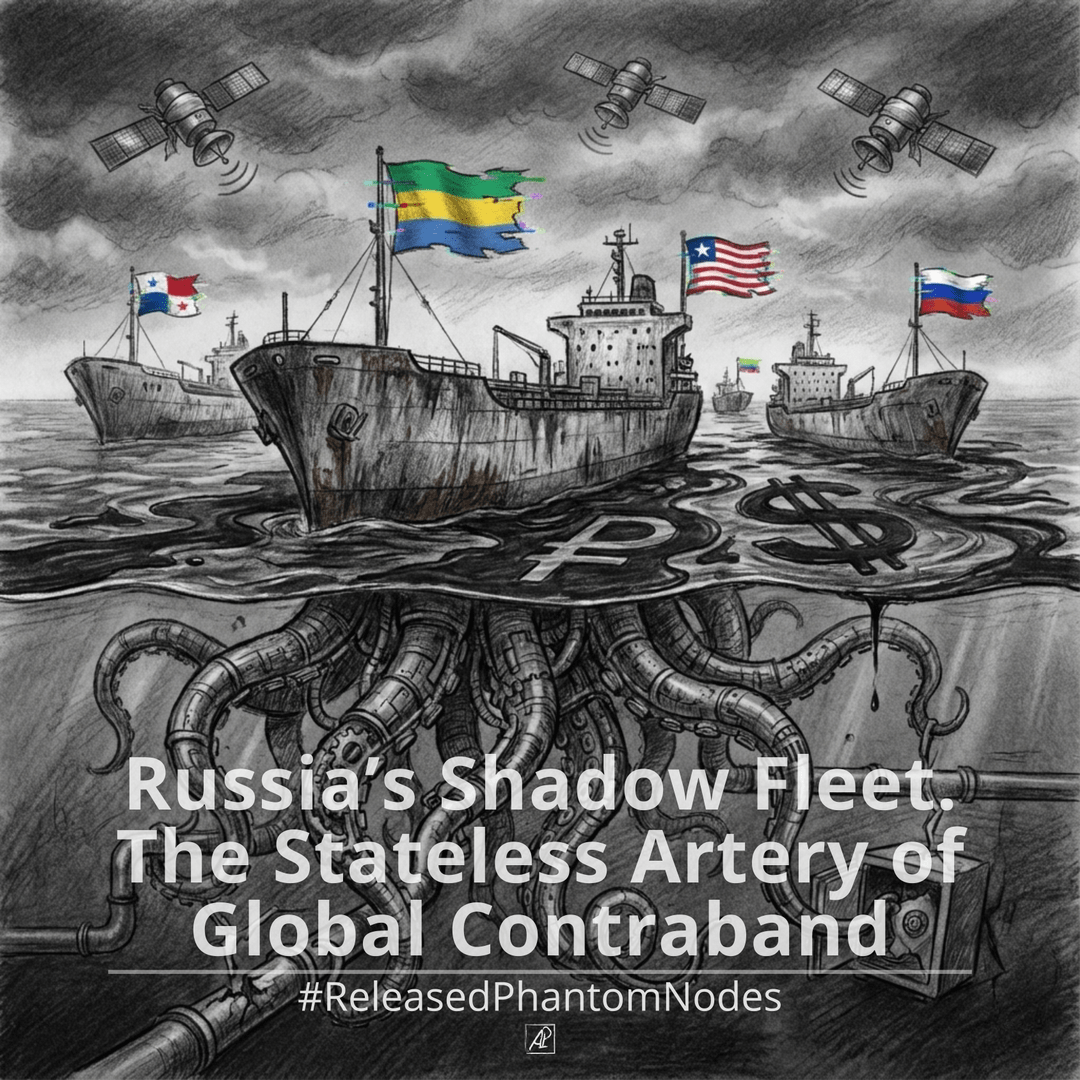
Rusting ghost ships drifting between blind radar zones
What remains after the phantom:
Schemes, ecological risk, ownerless financial trails
Core of the node:
What sustained it?
Flags of convenience, single-vessel shell companies, shadow insurance clubs, and offshore STS transfers.
How did it become a phantom?
The fleet shed national identity through constant changes of flags, owners, and digital footprints.
Why does the phantom still exist?
Due to the gap between maritime law, financial oversight, and political enforcement.
Phantom’s condition:
Active, mobile, degraded, legally diffused
After the regime:
– beneficial ownership exposed
– flags-of-convenience schemes dismantled
– STS transfers and AIS manipulation criminalized
– global audits of extraterritorial shipping conducted
– vessels and cargoes seized outside legal frameworks
– international maritime safety and accountability restored
Collective reaction:
The ocean is not a hiding place for crime.
Water remembers what registries erase.
Core principle:
Extraterritoriality without accountability becomes an engine of war.
Alt-text:
Graphite illustration of Russia’s shadow fleet: rusted ghost tankers with flickering flags drift across a stormy ocean, oil slicks forming currency symbols while satellites above appear blinded.
#ReleasedPhantomNodes #ShadowFleet #PoliticalDesign #PivtorakStudio #MemoryOn #ReleasedPhantomNode #Phantom #SanctionsEvasion #MaritimeLaw #EnvironmentalRisk #WarEconomy
Unmasking the Phantom. Pivtorak.Studio. 29.12.2025
🛡️ This project is an artistic and philosophical exploration.
All depictions are allegorical; the piece does not allege facts about specific private individuals without corroborated evidence.
Names are included because they appear in open international sources.
🫧 Phantom Node Dossier 102: Russia's Shadow Fleet. The "Maritime Anonymity and Jurisdictional Void" Regime.
Key Aspects of the Phantom:
"The Floating Financial Bunker." The Shadow Fleet consists of hundreds of aging tankers with opaque ownership, facilitating Russian oil exports in defiance of the price cap. It is the node where the material (oil) becomes phantom (flag-hopping, disabling radars) only to rematerialize as cash for war. It is a "state beyond law" that has turned the world’s oceans into an unregulated profit zone for the aggressor.
Regimes:
🌊 Jurisdictional Void Regime: Utilizing "flags of convenience" (Gabon, Panama, Liberia) so that no state bears real responsibility for the vessel's actions.
🛡️ Shadow Insurance Regime: Creating unbacked, self-styled insurance schemes, allowing ships to enter ports while ignoring Western P&I clubs.
🌑 Radio-Electronic Camouflage Regime: Systematic violation of international shipping rules through the manipulation of AIS (Automatic Identification System).
🩸 Environmental Terrorism Regime: Conscious use of sub-standard vessels, where the risk of an oil spill acts as a tool of blackmail against the global community.
Tools:
🚢 Single-Ship Shell Companies: Each tanker is owned by a separate company in the Marshall Islands or UAE, making legal pursuit virtually impossible.
⚓ STS (Ship-to-Ship) Transfers: Transferring oil between vessels in the open sea (often at night with lights off) to obscure the cargo's origin.
🚩 Flag Hopping: Constantly changing the vessel’s registered flag during a single voyage to confuse regulators.
🛠️ Technological "Zombification": Utilizing tankers that should have been scrapped long ago as primary transport assets.
Civilizational Influences:
📉 Degradation of International Maritime Law: Dismantling the maritime safety system built over decades following the Exxon Valdez disaster.
☣️ Financial Detox of the Aggressor: Directly securing 40-50% of Russian budget revenues, rendering sanctions "leaky."
🌍 Global Ecological Threat: Turning the coastlines of Europe and Asia into potential disaster zones via the "ghost fleet."
🩸 The Economic Bedrock of War: Without the shadow fleet, the RF’s military machine would stall due to a lack of foreign currency within months.
Dissection of a Phantom Node. Pivtorak.Studio. 29.12.2025
🛡️ This project is an artistic and philosophical exploration. Depictions are allegorical and do not allege facts about private individuals without corroborated evidence.
Names are included because they appear in open international sources.