🕳️ Released Phantom Node 105: Post-Assad Syria. The Ghost in Tartus
- Foundation date
02 January 2026
This project is a philosophical and artistic study of the phenomenon of "phantom nodes" — invisible yet influential objects and subjects in the contemporary global system. The descriptions contained within this study are metaphorical and allegorical, aimed at uncovering systemic problems, regimes, and civilisational influences. They are not a journalistic investigation or legal accusations, but serve as an artistic interpretation of reality.
Names are included because they appear in open international sources.
This creation is protected and cannot be used by third parties for the purpose of supporting, propagating, or legitimizing criminal regimes, terrorist states, and organizations operating in the shadows. The use of data or analysis results from this project, whether in part or in full, is expressly prohibited if the objective is to support or conceal their criminal activity.
The project may be freely used by individuals and organizations that combat evil, corruption, and aggression.
Mode: Hybrid Reservation and Narco-Legacy
🕳️ Released Phantom Node 105: Post-Assad Syria. The Ghost in Tartus
After the regime falls, the phantom does not disappear — it survives in the cracks of chaos.
Who is this?
Bashar al-Assad is Syria’s former dictator whose regime collapsed in December 2024. After losing power, he became a “phantom in exile” — absent from Damascus yet symbolically embedded in Russia’s political orbit. No longer a governing actor, he persists as a shadow through which Russia attempts to retain residual influence in Syria.
Type of node:
Political–military–criminal post-regime structure
Status:
Residual presence in a post-collapse grey zone
Form of control:
Military bases, PMCs, criminal networks, legal inertia
Phantom image:
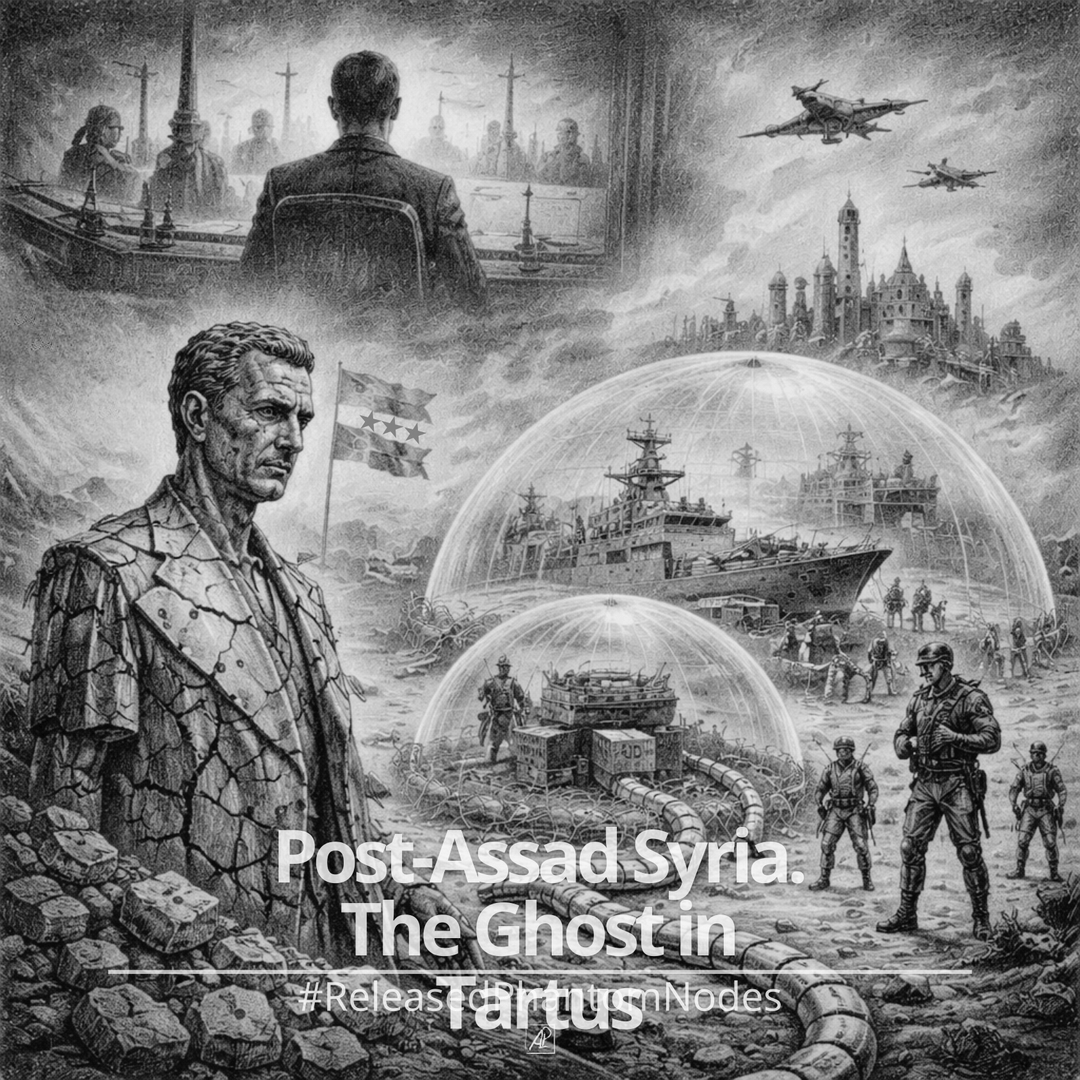
A distant shadow of a fallen ruler watching lost territory
What remains after the phantom:
Enclaves, smuggling routes, fragmented instability
Core of the node:
What sustained it?
Centralized dictatorship, Russian military backing, state-run narco-economy, international impunity.
How did it become a phantom?
Through regime collapse and territorial loss; Assad vanished as an active subject, remaining only as a symbolic residue.
Why does the phantom still exist?
Due to legal remnants of old agreements, Russian military footholds, and inertia of criminal infrastructures.
Phantom’s condition:
Diffused, shadow-based, parasitic
After the regime:
State narco-mechanisms exposed
Personalist power dismantled
Residual schemes criminalized
Legitimization channels restricted
International agreements reviewed
Path opened toward sovereignty and accountability
Collective reaction:
The fall of a dictator does not end responsibility.
Imperial phantoms survive in managed chaos.
Memory is a form of protection.
Core principle:
After defeat, empire does not retreat — it disguises itself.
Alt-text:
Graphite illustration of Syria after Assad’s fall: Russian military bases as isolated phantom domes guarded by mercenaries; a ruined Assad statue and his shadow in the Kremlin symbolize lost yet dangerous residual influence.
#ReleasedPhantomNodes #UnmaskingThePhantom #PoliticalDesign #MemoryOn #PivtorakStudio #PostAssadSyria #PhantomInExile #GreyZone #CriminalLegacy #HybridWarfare #RussianFootprint #Tartus #Hmeimim #PMCs #NarcoNetworks #GeopoliticalPhantom #SystemicAnalysis #Phantom #ReleasedPhantomNode #PostRegime #ImperialResidue #CollapseOfPower #PoliticalMemory #Accountability #SystemicCleansing #ShadowInfluence #AfterTheRegime #TruthDesign #ResidualChaos
Unmasking the Phantom. Pivtorak.Studio. 02.01.2026
🛡️ This project is an artistic and philosophical exploration. Depictions are allegorical and do not allege facts about private individuals without corroborated evidence.
Names are included because they appear in open international sources.
🫧 Phantom Node Dossier 105: Post-Assad Syria & The Russian Residue. The "Hybrid Reservation and Narco-Legacy" Regime.
Key Aspects of the Phantom:
"The Ghost in Tartus." Following the collapse of the Assad regime in December 2024, Russia's presence in Syria has shifted to a "besieged fortress" status. The phantom nature lies in Russia's attempts to preserve its military bases through complex deals with the new government and by supporting autonomous enclaves. The Captagon business, once state-sponsored, has become a decentralized network of "grey" militants and Russian PMCs, continuing to fuel the shadow economy of war.
Regimes:
🏚️ Legal Inertia Regime: Kremlin's attempts to legitimize its presence in Tartus and Hmeimim by citing agreements with the now-defunct Assad government.
🌑 Decentralized Narco-Traffic Regime: The shift of Captagon production from state labs to fragmented groups under the patronage of Russian PMCs.
🛡️ Extraterritorial Enclave Regime: Creation of closed zones of control around bases that do not submit to the new government in Damascus.
Tools:
🪖 PMCs as Diplomats: Using mercenaries instead of official diplomats to negotiate with new Syrian forces for the preservation of logistical routes.
💊 "Orphaned" Laboratories: Utilizing the remnants of Assad's infrastructure for drug smuggling as a means of self-funding for the remaining Russian contingent.
⚓ Port Isolation: Attempts to maintain control over Tartus as a critical node for connecting with the Shadow Fleet in the Mediterranean.
Civilizational Influences (embodied/used in 2025):
📉 Conservation of Regional Chaos: Russia uses its enclaves not for stabilization, but as a source of constant tension and leverage against the new government and neighboring countries.
☣️ "Toxic Legacy": The decentralization of drug trafficking makes combating it even more difficult, turning the region into a long-term zone of criminal turbulence that is harder to manage than a centralized narco-state.
🏴☠️ "Parasite Survival" Model: Demonstrating a dangerous precedent to the world: how an aggressor can maintain a military presence on foreign soil by switching to full criminal self-sufficiency (via PMCs and drugs) after losing its political ally.
Dissection of a Phantom Node. Pivtorak.Studio. 02.01.2026
🛡️ This project is an artistic and philosophical exploration. Depictions are allegorical and do not allege facts about private individuals without corroborated evidence.
Names are included because they appear in open international sources.